
Frogs are environmental sentinels: their sensitive skin reveals how their surroundings are changing.
This Fondecyt project studies the Chilean giant frog, the four-eyed frog and the invasive African clawed frog in 100 bodies of water across central and southern Chile, analyzing their skin bacteria, parasites and pathogens to understand human impact and protect native species.
A silent crisis
Amphibians are among the most threatened animal groups on the planet. Habitat loss and fragmentation, climate change and pollution are accelerating the loss of biodiversity. On top of this, a fungus called Batrachochytrium dendrobatidis (Bd), considered one of the greatest threats to amphibians worldwide, has spread with globalization.
An invader in our waters
In Chile, the African clawed frog (Xenopus laevis), an introduced species, puts additional pressure on native frogs. It not only competes with them but can also act as a reservoir for the Bd fungus and help it spread, endangering species found nowhere else in the world.
Skin as a shield
Besides fungi, amphibians can carry mites on their skin and parasites in their blood. But their skin also protects them: it is covered in beneficial bacteria, known as the skin microbiome, which acts as a natural barrier against disease. This invisible shield can change when human activity alters the environment.
How we study it
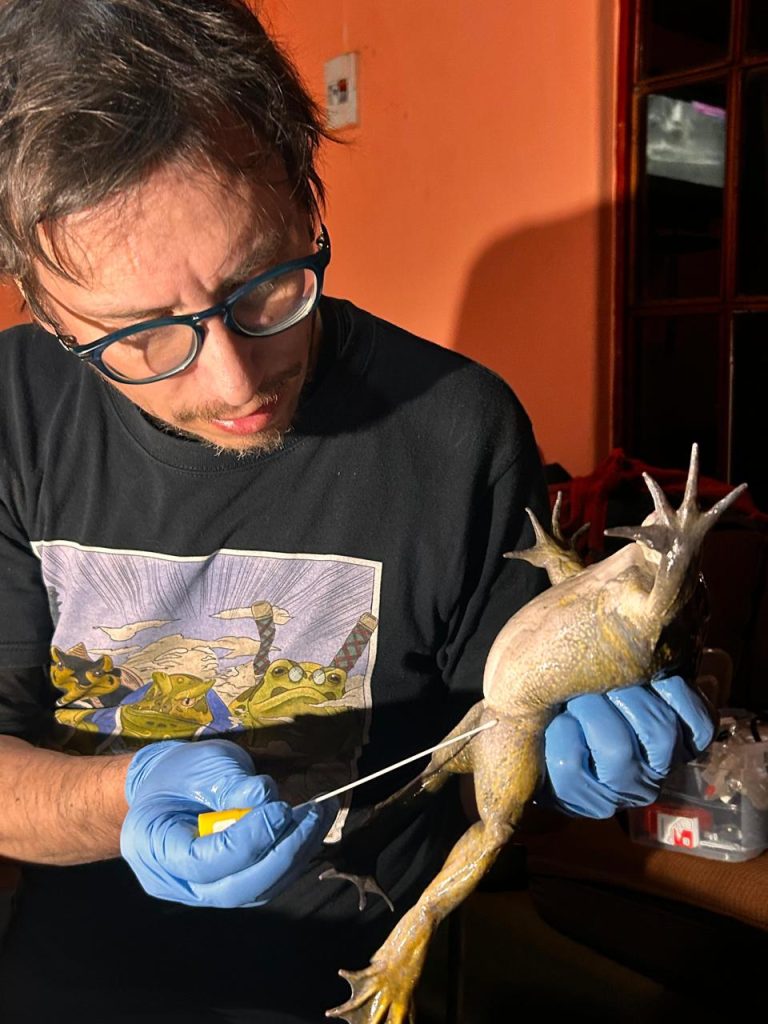
The team will visit each of 100 bodies of water in central and southern Chile five times to record which species are present. From 15 individuals per species, skin and blood samples will be taken to analyze their bacteria through genetic sequencing, detect the Bd fungus with PCR and identify internal and external parasites.
What we hope to learn
We expect to find that human disturbance, pathogens and the presence of the African clawed frog alter the skin microbiome and reduce the presence of native species. By combining ecological, parasitological and microbiological data, this study will help design better conservation strategies in the face of the global amphibian crisis.
Die through the skin: the effects of invasive species, anthropogenic perturbation, and pathogens on the occupancy and microbiome of two endemic amphibians in Chile