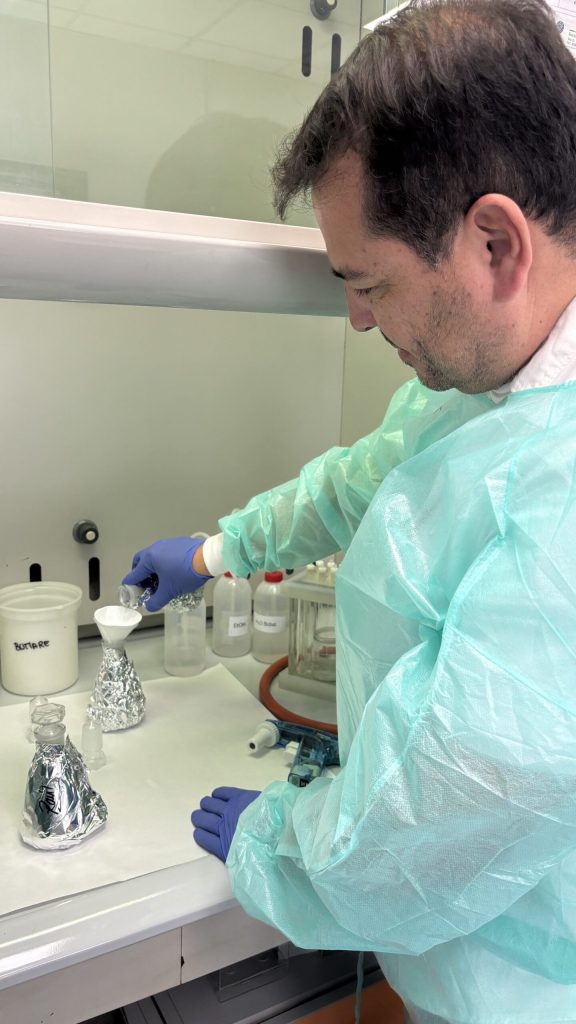

PFAS, known as “forever chemicals,” are compounds that barely break down and can end up in our food.
This international project, funded by the International Atomic Energy Agency (IAEA), studies how these chemicals move from fertilizers into soil, water and crops, to help protect public health and food safety.
Chemicals that don’t go away
PFAS are a group of highly persistent synthetic chemicals, which is why they are called “forever chemicals.” Once in the environment, they can move through water, soil and plants. That means they can end up in the food we eat, raising concerns about their possible effects on human health.
From fertilizer to crop
In earlier research, the team found PFAS in inorganic and organic fertilizers and in biosolids. The concentrations were equal to or higher than those reported internationally. This suggests that agricultural inputs could be a pathway for these chemicals into crops, an issue that remains largely unexplored in Latin America.
What we study
Over four years, the team will analyze a selected group of PFAS across the agri-food system, from agricultural inputs to crops. The focus will be on how these compounds transfer from fertilizers to plants, how they move through the environment and how much they accumulate in crops.
An international collaboration
The project brings together researchers from UDLA and the Universidad de Santiago de Chile. Specialists from the Czech Republic, Canada and the United States will help analyze the samples. The IAEA selected the proposal in a highly competitive process.
What we hope to achieve
We expect to generate evidence on PFAS exposure pathways and support environmental and food monitoring. This information can guide decision-makers toward monitoring programs and possible future regulation of these compounds in Chile.
Integrated Assessment of PFAS Behavior in Agri-Food Systems: From Agricultural Inputs to Crop Accumulation